
Hello everyone, we’re back with another weekly blog post, and today is going to be about National Stroke Awareness Month. Strokes are massive health hazards that can happen to most people and often have long-lasting or permanent consequences. Let’s begin by looking at what a stroke is, and what causes a stroke.
What is a Stroke, or “Brain Attack”?
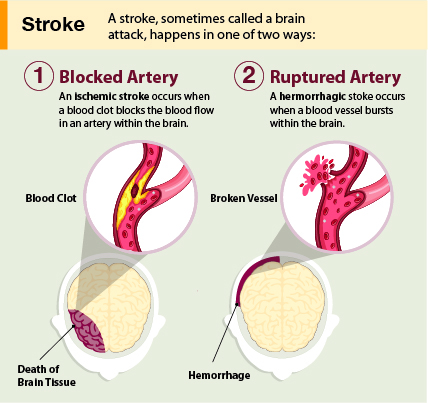
According to the Centers for Disease Control and Prevention, “A stroke, sometimes called a brain attack, occurs when something blocks blood supply to part of the brain or when a blood vessel in the brain bursts. In either case, parts of the brain become damaged or die. A stroke can cause lasting brain damage, long-term disability, or even death.”
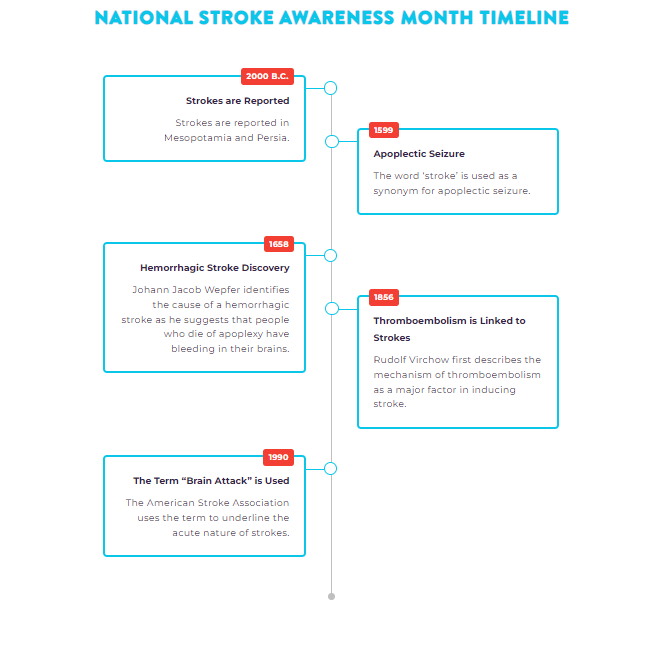
Strokes have been reported as far back as 2000 B.C. in ancient Mesopotamia and Persia. It was first described by Hippocrates as he discovered the phenomenon of sudden paralysis that is often associated with ischemia. He called the condition ‘apoplexy,’ which is Greek for ‘struck down with violence.’ In 1599, the word stroke was used as a synonym for apoplectic seizure and is a fairly literal translation of the Greek term.
In 1658, Johann Jacob Wepfer identified the cause of hemorrhagic stroke when he suggested that people who had died of apoplexy had bleeding in their brains. He also identified the main arteries supplying the brain – the vertebral and carotid arteries – and identified the cause of a type of ischemic stroke known as a cerebral infarction when he suggested that a blockage to those vessels might cause apoplexy. Rudolf Virchow first described the mechanism of thromboembolism in 1856 as a major factor in inducing stroke. Thromboembolism is a condition when a blood clot that forms in a blood vessel breaks loose, is carried by the bloodstream, and blocks another blood vessel. This can affect multiple organs, causing organ damage and even death.
The term “brain attack” was introduced to underline the acute nature of stroke according to the American Stroke Association, and the term has been used since 1990. It is used colloquially to refer to both ischemic as well as hemorrhagic strokes. Annually, more than 795,000 people in America have a stroke. Of this number, approximately 610,000 are people having their first stroke.
What happens in the brain during a stroke?
The brain controls our movements, stores our memories, and is the source of our thoughts, emotions, and language. The brain also controls many functions of the body, like breathing and digestion.
To work properly, your brain needs oxygen. Your arteries deliver oxygen-rich blood to all parts of your brain. If something happens to block the flow of blood, brain cells start to die within minutes, because they can’t get oxygen. This causes a stroke. Some facts about strokes include:
- Stroke can happen to anyone at any age.
- 80% of all strokes are preventable.
- Stroke is the fifth leading cause of death in the U.S. and a leading cause of severe disability.
- On average, one person dies from a stroke every 4 minutes.
- More than 795,000 people have a stroke each year in the U.S.
- Stroke kills almost 130,000 of the 800,000 Americans who die of cardiovascular disease each year—that’s 1 out of every 19 deaths from all causes.
What are the types of stroke?
There are two types of stroke:
- Ischemic stroke.
- Hemorrhagic stroke.
A transient ischemic attack (TIA) is sometimes called a “mini-stroke.” It is different from the major types of stroke, because blood flow to the brain is blocked for only a short time—usually no more than 5 minutes.
TIAs are sometimes known as “warning strokes.” It is important to know that
- A TIA is a warning sign of a future stroke.
- A TIA is a medical emergency, just like a major stroke.
- Strokes and TIAs require emergency care. Call 9-1-1 or your corresponding emergency line right away if you feel signs of a stroke or see symptoms in someone around you.
- There is no way to know in the beginning whether symptoms are from a TIA or from a major type of stroke.
- Like ischemic strokes, blood clots often cause TIAs.
- More than a third of people who have a TIA and don’t get treatment have a major stroke within 1 year. As many as 10% to 15% of people will have a major stroke within 3 months of a TIA.
Recognizing and treating TIAs can lower the risk of a major stroke. If you have a TIA, your healthcare team can find the cause and take steps to prevent a major stroke.
Ischemic stroke
Most strokes are ischemic strokes. An ischemic stroke occurs when blood clots or other particles block the blood vessels in the brain. Fatty deposits called plaque can also cause blockages by building up in the blood vessels.
Hemorrhagic stroke
A hemorrhagic stroke happens when an artery in the brain leaks blood or ruptures (breaks open). The leaked blood puts too much pressure on brain cells, which damages them. High blood pressure and aneurysms—balloon-like bulges in an artery that can stretch and burst—are examples of conditions that can cause a hemorrhagic stroke.
Signs of Stroke
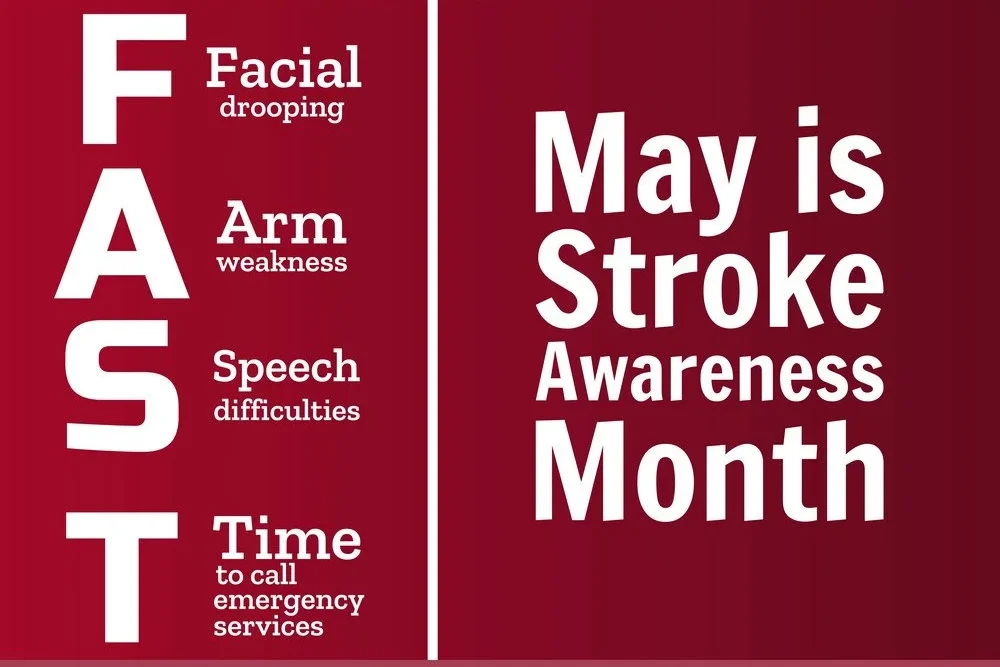
There are a few signs that a person is having a stroke, the main ones can be identified using the F.A.S.T. acronym:
F.A.S.T. Warning Signs
Use the letters in F.A.S.T. to Spot a Stroke
- F = Face Drooping – Does one side of the face droop or is it numb? Ask the person to smile. Is the person’s smile uneven?
- A = Arm Weakness – Is one arm weak or numb? Ask the person to raise both arms. Does one arm drift downward?
- S = Speech Difficulty – Is speech slurred?
- T = Time to call 911
Other Stroke Symptoms
Watch for Sudden:
- NUMBNESS or weakness of face, arm, or leg, especially on one side of the body
- CONFUSION, trouble speaking or understanding speech
- TROUBLE SEEING in one or both eyes
- TROUBLE WALKING, dizziness, loss of balance or coordination
- SEVERE HEADACHE with no known cause
How To Observe National Stroke Awareness Month
- Go for a checkup: The brain is a very important part of the body that controls most functions. It should be taken care of by going for regular checkups to make sure it is in a healthy state.
- Spread awareness: Spread awareness about stroke, its dangers, and how to prevent it. Improving the general knowledge around strokes will reduce the number of people who suffer from strokes.
Conclusion
This month is the perfect opportunity to spread awareness about the dangers of stroke, and how to go about preventing them. You could be saving a life, maybe even your own!