

Part of our mission for National Immunization Awareness Month is to spread awareness about the benefits and importance of vaccines. Vaccines have transformed the course of human history, preventing and eradicating diseases that once wreaked havoc on communities. From smallpox to polio, vaccines have saved countless lives and paved the way for healthier societies. In this article, we’ll present to you 10 of the most important vaccines that have been created in the history of mankind which have helped to shape the new world we know today.
1. 1924 – Tetanus Toxoid
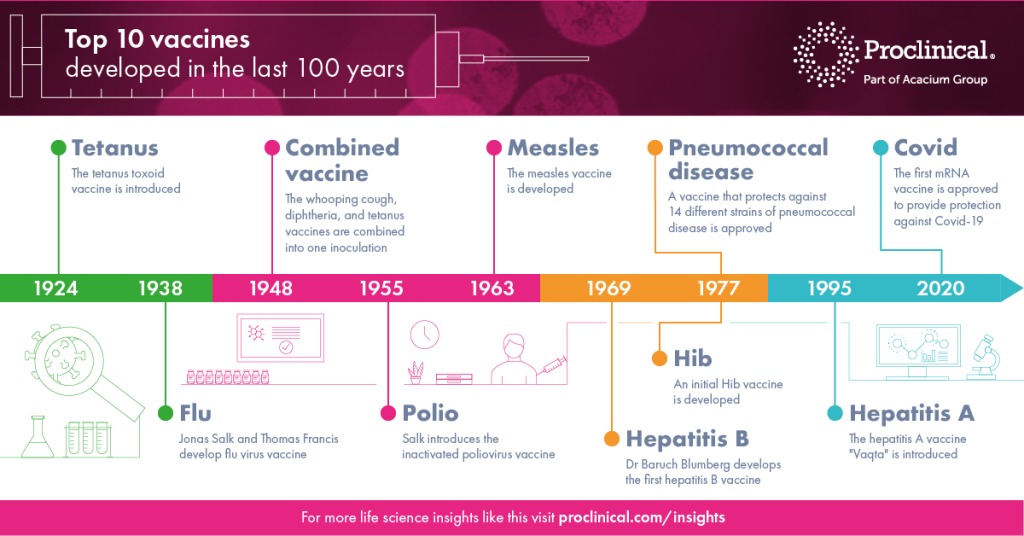
The tetanus toxoid vaccination was introduced in 1924 as a result of a method for inactivating tetanus toxin using formaldehyde that was developed in the early 1920s. The injection was initially widely utilized in World War II to protect soldiers, and as a result of its wide use, tetanus cases decreased by 95%. Today, booster doses of tetanus toxoid are given every 10 years to maintain immunity. Tetanus toxoid vaccines are routinely advised for both children and adults.
2. 1938 - Flu virus
When British researchers Wilson Smith, C.H. Andrewes, and P.P. Laidlaw discovered no bacteria in throat washings from patients with influenza in the early 1930s, they realized the disease was caused by a virus. Following this finding, Thomas Francis and Jonas Salk went on to create the first ever flu vaccine. Before being licensed for widespread use in 1945, the vaccination first underwent safety and efficacy testing on members of the US military.
3. 1948 - Whooping cough, diphtheria, and tetanus
The DTP (diphtheria, tetanus, and pertussis) combination vaccination was created in the 1940s after scientists realized the advantages of combining three vaccines into one. The combination vaccination was first handed out in 1948, and one year later it received FDA approval in the US. It quickly evolved into a standard childhood vaccination. The diphtheria-tetanus-acellular pertussis (DTaP) vaccine, which was shown to have less adverse effects and was regarded to be safer than DTP, replaced DTP in 1991. Since the combination vaccine was first introduced, it has significantly reduced the occurrences of diphtheria, tetanus, and pertussis, which has led to thousands of lives being saved.
4. 1955 - Poliovirus
Polio (poliomyelitis) is a severe and potentially fatal disease that infects the spinal cord and causes paralysis. Before there were polio vaccines, annual outbreaks caused thousands of cases of paralysis throughout the world. Several scientists made substantial contributions to the creation of polio vaccinations during the beginning of the 20th century. A breakthrough was made by Jonas Salk and his team in the 1950s when they found a vaccination that eradicated strains of all three poliovirus kinds (poliovirus types 1, 2, and 3). The “Polio Pioneers” experiment involved extensive clinical testing, and in 1955 it was found to be both extremely safe and highly effective at preventing polio.
5. 1963 - Measles
When virologist John F. Enders and his team of researchers discovered they could successfully isolate the measles virus and use it to make a weakened form of the virus for injection purposes, they developed the first measles vaccine in history. It was discovered that the vaccine caused the immune system to create antibodies that provide lifelong immunity against measles. Measles has been eradicated in numerous nations and areas across the globe since it was first introduced in the 1960s. However, outbreaks continue to happen in places with lower vaccination rates or in populations that are more vulnerable.
6. 1969 – Hepatitis B
The hepatitis B virus was discovered in the 1960s and has since been established as a substantial cause of liver disease, making it a global health concern. Dr. Baruch Blumberg discovered the hepatitis B surface antigen (HBsAg) protein on the surface of the hepatitis B virus in 1969. This breakthrough paved the way for the essential hepatitis B vaccine to be developed. The early 1980s saw the emergence of recombinant DNA technology, which allowed scientists to clone the gene responsible for HBsAg synthesis, allowing them to make the protein in enormous numbers. Today, the recombinant hepatitis B vaccine is an essential component of immunization programs around the world, and it has significantly reduced the prevalence of new infections.
7. 1977 - Pneumococcal
Dr. Louis Pasteur and Dr. George Miller Sternberg recognized Pneumococcus as a prominent cause of pneumonia in the late nineteenth century. The first pneumococcal polysaccharide vaccine in history was approved for use in the United States in 1977. It contains pure capsular polysaccharide antigen from 14 different strains of pneumococci, preventing pneumonia.
8. 1977 – Haemophilus influenzae type B
Hib (Haemophilus influenzae type B) is a bacteria that can cause life-threatening diseases such as meningitis. Scientists made a significant breakthrough in understanding the biology of Hib and its capsule, a critical virulence component, in 1977. They devised methods for extracting a pure polysaccharide from the Hib capsule, which was utilized as the foundation for the first Hib vaccine. Since then, numerous generations of Hib vaccines have been created, each with enhanced safety and convenience of administration. These vaccines are now usually given to infants in a series of doses beginning when they are barely months old.
9. 1995 - Hepatitis A
Hepatitis A is a liver inflammation caused by the hepatitis A virus (HAV). It is spread by the consumption of contaminated food and drink, as well as through direct contact with an infectious person. It can cause major health issues such as organ failure. Prior to the vaccine, the primary methods of avoiding hepatitis A were hygiene and passive protection using immune globulin. The hepatitis A (HepA) vaccine, known as Vaqta, was developed by Maurice Hilleman and his colleagues at Merck & Co., one of the world’s major pharmaceutical corporations. This was approved for usage in the United States for the first time in 1995. The vaccine offers long-term protection against the hepatitis A virus and was first phased in for people living in high-risk locations.
By the millennium’s turn, the Hep A and Hep B vaccinations had been combined into a single injection known as Twinrix. The combination of these has reduced administrative expenses while increasing vaccine uptake.
10. 2020 - Covid-19
When the Covid-19 pandemic hit the world at the end of 2019 and early 2020, pharmaceutical companies scrambled to develop a vaccine to guard against the virus. By November 2020, promising results from phase III clinical studies were beginning to surface. Notably, Pfizer-BioNTech and Moderna reported high efficacy rates for their mRNA-based vaccines, and by December 2020, regulatory agencies such as the United States Food and Drug Administration (FDA), the European Medicines Agency (EMA), and others had granted Emergency Use Authorization (EUA) or conditional approvals for the Pfizer-BioNTech and Moderna vaccines, allowing widespread use. Other major pharmaceutical companies, including AstraZeneca and Johnson & Johnson, followed suit, illustrating the strength of teamwork, innovation, and global cooperation in tackling public health emergencies.
The rapid delivery of the world’s first mRNA-based vaccine, for Covid19, brought mRNA technology to the forefront. mRNA vaccines have a lot of promise for the future of vaccines due to their great effectiveness, rapid development, and possibility for low production costs.
Well, there you have it. The 10 most important vaccines that have been created in the last 100 years. If you enjoyed the article be sure to let us know in the comments below, and tune in next week for another fun and informative blog post. Have a great week ahead!

